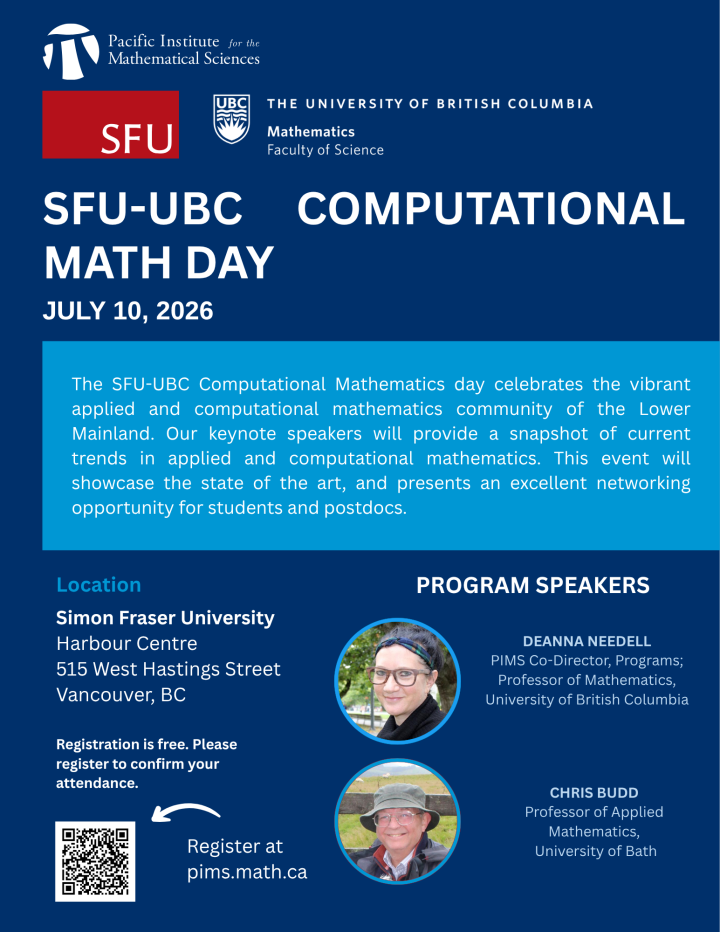
SFU-UBC Computational Math day
Topic
This half-day event features two invited speakers and a poster session for graduate students and postdoctoral fellows. Everyone in the applied mathematics, numerical analysis, and scientific computing fields at SFU and UBC is invited to attend.
Our keynote speakers will provide a snapshot of current trends in applied and computational mathematics. This event will showcase the state of the art, and presents an excellent networking opportunity for students and postdocs.
Speakers


Details
Event Schedule:
- 1:30-1:45 Welcome remarks
1:45-2:45 On Fairness and Foundations in AI, Deanna Needell, UBC
In this talk, we will discuss several areas of recent work centered around the themes of fairness and foundations in machine learning and AI as well as highlight the challenges in this area. We will discuss recent results involving linear algebraic tools for learning, such as methods in non-negative matrix factorization that include tailored approaches for fairness. Then, we will discuss new foundational results that theoretically justify phenomena like benign overfitting in neural networks. Lastly, we will mention some recent results on observational multiplicity, and how those can be utilized to improve equity. Throughout the talk, we will include example applications from collaborations with community partner s, using machine learning to help organizations with fairness and justice goals. This talk includes work joint with Erin George, Kedar Karhadkar, Lara Kassab, and Guido Montufar.
- 2:45:3:15 Coffee break
3:15-4:15 Equidistribution-based training of univariate free knot splines, PINNS, and ReLU neural networks, Chris Budd OBE, University of Bath
Authors: Chris Budd OBE (Bath), Simone Appela, Simon Arridge, Aengus Roberts,Teo Deveney, Lisa Kreusser
We consider the problem of improving the accuracy, convergence, and conditioning of univariate nonlinear function approximations using (mainly) shallow neural networks (NN) with a rectified linear unit (ReLU) activation function. The standard L_2 based approximation problem is ill-conditioned and the behaviour of the optimisation algorithms used in training these networks degrades rapidly as the width of the network increases. This can lead to significantly poorer approximation in practice than we would expect from the theoretical expressivity of the ReLU NN architecture. Univariate shallow ReLU NNs and traditional approximation methods, such as univariate Free Knot Splines (FKS) span the same function space, and thus have the same theoretical expressivity.
However, the FKS representation, both remains well-conditioned as the number of knots increases, and can be highly accurate if the knots are correctly placed. We leverage the theory of optimal piecewise linear interpolants to improve the training procedure for both a FKS and a ReLU NN. For the FKS we propose a novel two-level training procedure. First solving the nonlinear problem of finding the optimal knot locations of the interpolating FKS using an equidistribution approach. Then solving the nearly linear, well-conditioned, problem of finding the optimal weights and knots of the FKS.
The training of the FKS gives insights into how we can train a ReLU NN effectively to give an equally accurate approximation. To do this we combine the training of the ReLU NN with an equidistribution based loss to find the breakpoints of the ReLU functions, this is then combined with preconditioning the ReLU NN approximation (to take an FKS form) to find the scalings of the ReLU, functions. This procedure leads to a fast, well-conditioned and reliable method of finding an accurate shallow ReLU NN approximation to a univariate target function. This method avoids spectral bias and is highly effective for a wide variety of functions. We test this method on a series of regular, singular, and rapidly varying target functions and obtain good results, realising the expressivity of the shallow ReLU network in all cases. We conclude that in the shallow case to gain full expressivity for the ReLU NN we must both find the optimal breakpoints (by equidistribution) and precondition the problem of finding the optimal coefficients. We then extend our results to more general activation functions, and to deeper networks.
We then apply this methodology to the PINNS and DRM Machine learning methods for solving differential equations, showing that this leads to more accurate and stable schemes.
- 4:15-5:30 Poster session